

Pneumatic conveying solutions for various dye powders
During the processing and transportation of dye powders, enterprises often face issues such as dust flying, moisture absorption of materials, cross-contamination, and low manual handling efficiency. Traditional manual operation not only poses health and safety risks, but also struggles to meet the stability and cleanliness requirements of continuous production. How to achieve sealed, efficient, and low-damage material transport has become a common challenge urgently needed in the dye industry.
Analysis of dye powder material characteristics
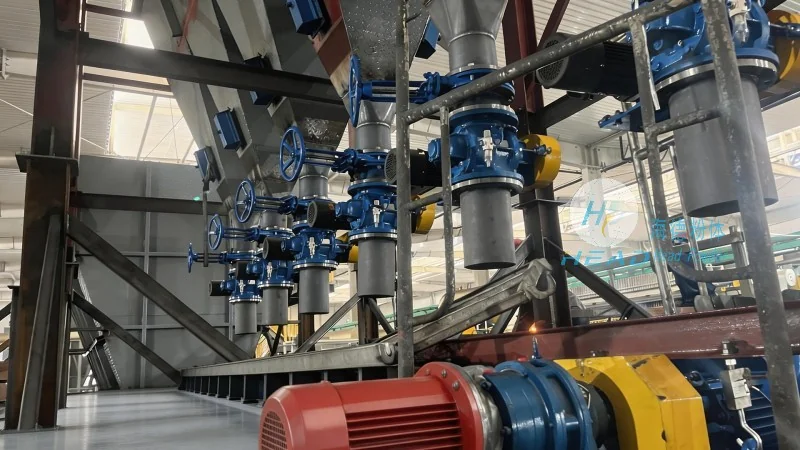
Dye powders have fine particle size, large density differences, are prone to moisture absorption and caking, and some varieties exhibit static electricity or adhesion. These physical properties determine that the conveying system should have good sealing, explosion-proof design, anti-stick material properties, and relatively accurate control logic to avoid deposition, blockage, or changes in material properties within the pipeline.
Pneumatic conveying system solution for dye powder
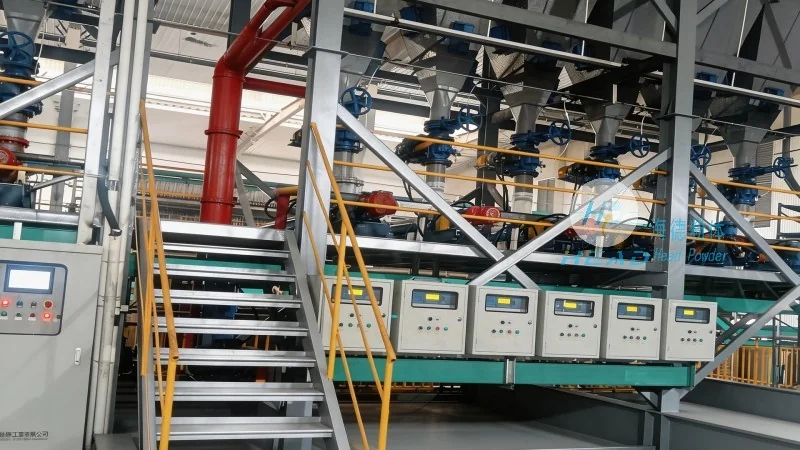
Head Powder offers customized pneumatic conveying system equipment for various dye powders, using either positive or negative pressure pneumatic conveying methods to meet different process requirements. Core components include feeding devices, gas supply equipment, conveying pipelines, separation devices, and automatic control systems. Depending on material characteristics, you can choose a rotary feeder, Venturi injector, or dense-phase pump conveying mechanism, achieving fully sealed, automated conveying from the raw material silo to the point of use.
Main features of the system solution
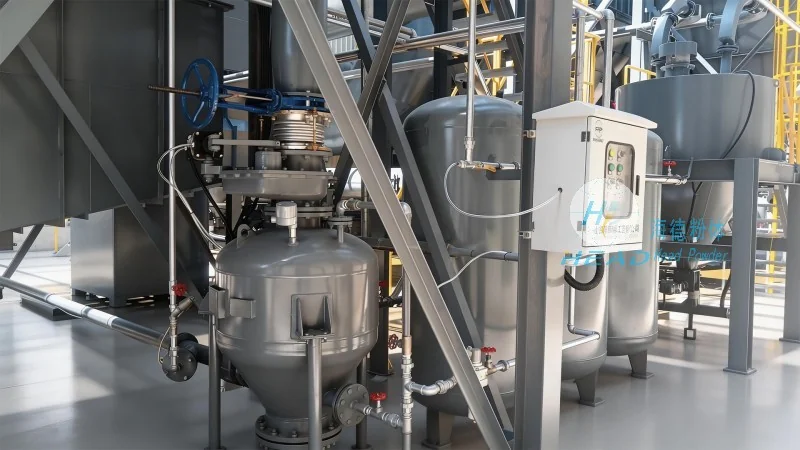
To address customer pain points, the system uses fully sealed pipelines to eliminate dust leakage, combined with anti-static and explosion-proof measures to support safety; Uses pulse back-blowing or vibration-assisted design to reduce material adhesion to walls, supporting smooth conveying; PLC and variable frequency control enable more accurate ingredient batching and remote monitoring, reducing manual intervention. The overall solution not only improves efficiency but also significantly enhances the production environment, reduces material waste, and meets the dye industry's demand for cleaner and smarter production.